
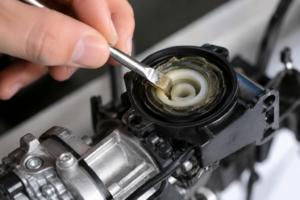
Common Mistakes When Applying Nyogel Grease (And How to Avoid Them)
Are You Applying Nyogel Grease Correctly?
Nyogel grease is trusted for improving the feel, performance, and lifespan of mechanical components. From automotive controls and camera lenses to electronic switches and industrial equipment, it provides smooth, controlled movement while reducing wear and noise.
However, even the best damping grease won’t perform as expected if it’s applied incorrectly. Simple mistakes, such as using too much grease or applying it to dirty surfaces, can reduce its effectiveness and even shorten the life of your components.
Here are the most common mistakes people make when applying Nyogel grease and how to avoid them.
1. Applying Too Much Grease
One of the biggest misconceptions is that more grease means better lubrication. In reality, applying too much Nyogel can create excessive resistance, attract dust and dirt, and make components feel stiff.
Instead, apply only a thin, even layer to the contact surfaces. A small amount is usually enough to provide smooth damping and proper lubrication.
🔗 Learn more about Nyogel products and applications: https://www.nyelubricants.com/products/nyogel/
2. Skipping Surface Cleaning
Applying grease over old lubricant, dirt, or debris prevents Nyogel from bonding properly with the surface.
Before applying fresh grease:
-
Remove old lubricant.
-
Clean the contact surfaces thoroughly.
-
Allow the parts to dry completely before application.
A clean surface helps ensure consistent performance and longer-lasting lubrication.
3. Using the Wrong Nyogel Formulation
Not every Nyogel grease is designed for the same purpose. Different formulations offer different damping levels and are intended for specific applications.
For example, one product may provide light damping for rotary knobs, while another is designed for higher resistance in precision controls.
Choosing the correct formulation helps achieve the desired feel and protects your components more effectively.
4. Mixing Nyogel with Other Greases
Mixing different types of lubricants can reduce performance or cause compatibility issues. Different grease formulations may react differently, affecting consistency and damping properties.
For the best results, completely remove any existing lubricant before applying Nyogel.
According to Machinery Lubrication, mixing incompatible greases can negatively affect lubrication performance and equipment reliability.
🔗 Related reading: https://www.machinerylubrication.com/
5. Ignoring Material Compatibility
Some mechanical components contain plastics, elastomers, or specialized materials that require compatible lubricants.
Although many Nyogel products are designed for use with a wide range of engineering materials, it’s always a good idea to verify compatibility before application, especially for sensitive components.
6. Applying Grease Unevenly
Uneven application can create inconsistent movement. Some areas may receive too much damping, while others receive too little.
To avoid this:
-
Apply grease evenly across the contact surface.
-
Use the recommended amount.
-
Remove excess grease if necessary.
This helps maintain smooth, controlled motion throughout the component.
7. Forgetting Regular Inspection
Even high-quality lubricants should be checked periodically, especially in equipment exposed to heavy use, dust, vibration, or changing temperatures.
Routine inspections help identify:
-
Contamination
-
Grease degradation
-
Excess wear
-
Need for reapplication